Financial Mathematics (Click on Pictures / Links)
 |
Scientific Machine Learning for Continuous Universal
Portfolios: In this paper, we illustrate how combining scientific machine learning with Dynamic Mode Decomposition solves high-dimensional portfolio optimization under real-world frictions. We model asset prices using a dual-noise framework to account for both instantaneous volatility and persistent trend-following dynamics. Our algorithm establishes an optimal No-Trade Region, allowing portfolio weights to float naturally until fundamental regime changes require execution. Consequently, our model scales polynomially to handle portfolios with over a hundred assets in real time, drastically reducing trading fees while preserving alpha during market stress. With J.-G. Aguilar and M. Gunzburger Communications on Applied Mathematics and Computation, Accepted, 2026. |
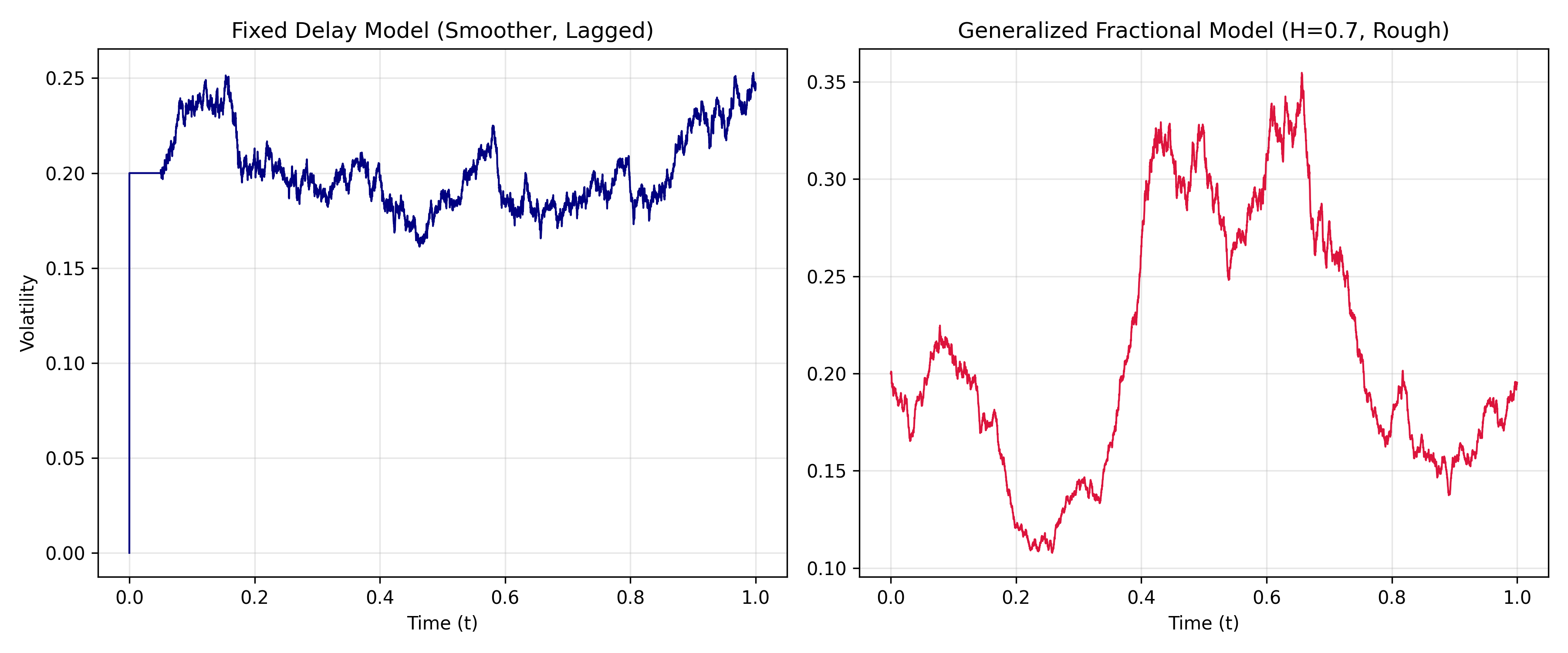 |
Stochastic Control of Mittag-Leffler Volatility Models: Standard diffusion models in quantitative finance cannot account for the multi-scale phenomena of roughness at high frequencies and lengthy memory persistence over long horizons. Here we present a Generalized Hybrid Volatility Model with non-singular Mittag-Leffler (ML) kernel. This paradigm provides two physically interpretable parameters: the fractional order $\alpha$ describing the local roughness of microstructure noise and the decay rate $\lambda$ quantifying the information absorption rate of the market. We make three different theoretical contributions. First, we connect continuous-time stochastic analysis to discrete-time econometrics by showing that our fractional SDE is the continuous limit of the Fractionally Integrated GARCH (FIGARCH) process. We prove the explicit mapping $d = H^{-1/2}$ by the use of a Milstein approximation. Second, we develop a Stochastic Fractional Optimal Control Problem (SFOCP) to minimize the volatility risk. The non-singular kernel yields a well-posed system of Forward-Backward SDEs. The parameter $\lambda$ controls the Variance Inflation and prevents finite-time blow-ups in the control cost. Third, we introduce a unified numerical framework that combines Spectral Embedding for quick noise production and a Variational Finite Element Method (FEM) for the control solution. We demonstrate that the Mittag-Leffler kernel offers an improved framework for addressing tail risk, enabling a smooth transition from short-term roughness to long-term efficiency. With J.-G. Aguilar and M. Gunzburger International Journal of Control, Accepted, 2026. |
minsky-mfbm-data |
Minsky-mFBM Dataset & Numerical Benchmarks (Ratio-Dependent Financial Instability): This repository provides the supplementary datasets, empirical time-series benchmarks, and numerical simulation outputs accompanying our research on "Minsky Meets Arditi-Ginzburg: Ratio-Dependent Financial Instability and Business Cycles with Long-Range Memory" (Applied Mathematical Modelling, Accepted, 2026). It includes synthetic and calibrated trajectories driven by multifractional Brownian motion (mFBM) with time-varying Hurst exponent $H(t)$, capturing endogenous credit cycles, debt-to-income ratio dynamics, and long-range memory effects in macroeconomic instability. Click here to access the Dataset on Google Drive |